
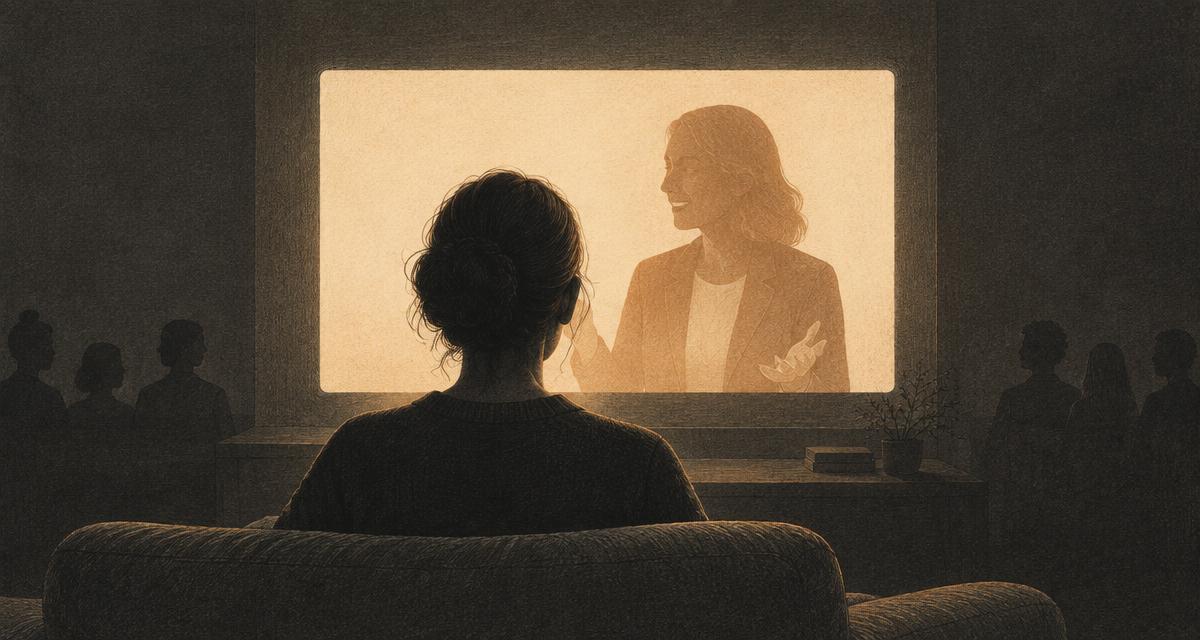
A parasocial relationship is the one sided bond you form with a person who does not know you exist. Parasocial relationships are now one of the most common forms of social connection, and most people never examine what the parasocial bond is doing for them or to them. Understanding parasocial meaning, where the bond comes from, and when it tips from comfort into substitution changes how you spend the attention you give it.
Why Do You Feel Like You Know Someone You Have Never Met?
There is probably a name you say out loud more often than the names of some of your relatives, and you have never met the person it belongs to. You know their voice, their laugh, the way they pause before answering a hard question. You have watched them through breakups, career changes, public apologies, and haircuts they clearly regretted. The feeling that you know them is not an illusion. It has a name, and the name is a parasocial relationship.
Psychologists define a parasocial relationship as a one sided bond: one person knows a great deal about the other, while the other does not know the first person exists. The asymmetry is the defining feature. Everything you feel is real, but nothing flows back. The person on the screen has never sat with your silence, and they never will. Yet your nervous system treats them as a person in your life, because from the inside, attention spent on someone is what a relationship is made of.
What makes this worth examining is not that the bond exists, but how much of it exists. For most of human history, the average person's social world was capped at the people they could physically encounter. Now a stranger with a microphone can occupy genuine relational space in millions of lives at once, without ever reciprocating a single one of them. Understanding what is happening in that exchange is one of the most practically useful things modern psychology has to offer, because the bond is doing something for you, and it is worth knowing what.
Where Did the Term Parasocial Come From?
The concept is older than the internet by several decades. In 1956, Donald Horton and Richard Wohl published a paper in the journal Psychiatry describing what they called para-social interaction. They were watching the early days of television, and they noticed something odd about the new style of hosts appearing on it. Announcers, interviewers, and performers were developing a manner of speaking that looked, shot by shot, like an intimate conversation: steady eye contact into the lens, direct address, the casual warmth of a friend dropping by rather than a stranger broadcasting.
Horton and Wohl's insight was that this intimacy was not an accident or a quirk of charming personalities. It was a technology. The direct address, the first names, the conversational tone all worked together to simulate the cues of face to face interaction, and audiences responded in kind, talking back to the screen, feeling addressed personally by programs watched by millions simultaneously. The performers were not pretending to have a relationship with any one viewer. They were creating the conditions under which each viewer alone would feel personally known.
What is striking about the 1956 paper is how little needed updating. Horton and Wohl understood that the parasocial bond was an ordinary consequence of the medium, not a symptom of pathology, and they were right. Later researchers, most prominently David Giles in his 2002 review of the literature, drew the line between parasocial interaction, the in the moment experience of feeling addressed during viewing, and parasocial relationships, the enduring bond that builds across many encounters over time. The first is a moment. The second is something closer to friendship, and friendships require no meeting to be real.
What Happens in Your Mind When You Watch Someone Every Day?
The machinery behind parasocial bonds is mostly ordinary social cognition running on unusual inputs. Repeated exposure to a face reliably increases liking for it, a finding so well established that it is usually called simply the mere exposure effect. Familiarity itself is pleasant, independent of content. Someone you have seen a hundred times is processed as part of your social world before you have decided anything about them. This is why morning show hosts, podcast voices, and daily vloggers accumulate affection that has little to do with what they actually say.
Layered on top of familiarity is the brain's habit of treating mediated social cues the way it treats in person ones. When a person on a screen looks into the camera, your visual system registers eye contact, and eye contact is one of the strongest social signals humans respond to. When they tell a personal story, your systems for intimacy register disclosure. When they address the audience as you, the word you is doing enormous quiet work, because you is the pronoun of being singled out, and being singled out is what attention feels like.
Over months and years, these inputs compile into something that functions like a relationship in your internal world. The person becomes part of your mental furniture. You know what they would say about a topic. You anticipate their reactions, borrow their phrases, feel proud of their achievements. None of this requires their participation. It requires only your repeated attention, which is the same raw material real relationships are built from, minus the parts where they can surprise, disappoint, or leave you.
Are Parasocial Relationships Bad for You?
The honest answer is that the research does not support the reflexive judgment people usually reach, which is that the whole thing is sad or pathetic. Parasocial bonds appear to do real work. They provide comfort during isolation. They offer models of behavior worth copying, from how someone handles criticism to how they talk about grief. For people with limited social contact, for shift workers, for those who have recently moved somewhere new, the bond can be a stabilizing presence rather than a poor substitute.
There is also something quietly useful about a relationship with no obligations in either direction. You can be as awkward, needy, or inconsistent as you like, and the bond does not suffer. It cannot. Some of what people get from parasocial attachment is unavailable anywhere else: an ever present, never judging, infinitely patient presence. That is not nothing, and pretending it is nothing just pushes the bond underground where it is harder to examine.
The problems begin when the bond changes jobs. A relationship with an unreachable person is harmless when it supplements your life and corrosive when it substitutes for it. The research on the harmful end of the spectrum points to a consistent pattern: the bond is doing damage when it starts carrying loads that real relationships should be carrying, like being your main source of feeling understood, your main outlet for care, or the thing your weekly structure is organized around. The bond itself is not the problem. The load it is carrying is.
Why Does Grief Feel Real When a Famous Person Dies?
When a public figure dies, a measurable fraction of their audience experiences something that looks and feels like bereavement: disbelief, intrusive thoughts, disrupted sleep, a need to talk about it repeatedly. Researchers who study this call it parasocial breakup, and the discomfort people feel about their own grief often comes from the mistaken belief that the grief is fake because the relationship was. The grief is real. What died was not the person, exactly. It was a presence in your daily life.
Grief is proportional to what was lost, not to whether the loss was mutual. You can lose a voice that was part of your mornings for a decade, a presence that accompanied your commutes and your cooking and your worst weeks, and the loss of that presence registers in the same machinery that loses people you knew. This is also why the deaths of fictional characters, and the endings of long running shows, produce genuine mourning. The bond was real. Only the reciprocity was fictional, and reciprocity was never what the bond was based on.
There is a second reason this grief catches people off guard. Parasocial relationships are never tested by ordinary friction, so when loss arrives there is no history of disappointment to soften it. Real relationships weather storms, which is part of why their endings, however painful, come with context. A parasocial loss arrives all at once, unsoftened by anything, and the mind has no rehearsal for it. If that has happened to you, the intensity was not an overreaction. It was the actual size of what you had.
How Do Algorithms and Livestreams Deepen the Bond?
Modern media has industrialized the mechanisms Horton and Wohl described in 1956. A livestream is parasocial interaction with the dials turned all the way up. The streamer reads comments aloud, uses viewers' names, answers questions, and remembers regulars. Every one of these behaviors is a reciprocity cue, a signal that suggests mutuality where there is none. A reply to your comment is a social event, and the feeling of being noticed is real even when the noticing is distributed across thousands of people at once.
Recommendation systems compound this. The algorithm's job is to keep you in the company of voices you respond to, which means it systematically selects for the parasocial cues that work on you personally. Over time your feed becomes a room full of people optimized to feel like your people: similar energy, similar humor, familiar rhythms. The sense of finding your community is genuine, but the selection process is mechanical, and mechanical selection never runs into the friction that real communities are built to handle.
The simplest way to grasp the scale of the change is to count hours. A neighbor might cross your path for thirty seconds a week. A favorite creator might be in your ears for twenty hours. The exposure math alone guarantees that the screen voice wins the familiarity contest, and familiarity is most of what the feeling of knowing is made of. You are not confusing them with a friend. You are simply spending friend level attention on them, and attention is what builds bonds, whichever direction it flows.
Who Forms the Strongest Parasocial Bonds?
The stereotype of the parasocially attached person, isolated and obsessive, is partly wrong and partly misleading. Early research did find correlations between loneliness and parasocial activity. Rubin, Perse, and Powell in 1985 found that loneliness related to how people used television, particularly local news viewing, and later work refined the picture considerably. Loneliness can make parasocial bonds more attractive, but strong bonds also form among socially rich people who simply love a performer's work.
What the research supports more reliably is that parasocial intensity spikes during life transitions. Adolescence is the obvious one, when identity is under construction and distant figures serve as templates for who to become. But moves, breakups, new jobs, illness, and new parenthood all qualify, because all of them scramble the social world you had, and a stable presence on a screen is one of the few things that does not get scrambled with it.
It is worth saying plainly that there is no diagnostic category here, and this article is not suggesting one. Parasocial relationships are a normal feature of media saturated life, like parking or daydreaming. The interesting question was never who has them. It is what they are doing, and whether the arrangement, if you looked at it honestly, is one you would have chosen on purpose.
When Has Yours Tipped Too Far?
There are signs, and they are less dramatic than people expect. The first is emotional dependency: your mood rises and falls with the content schedule. A creator's hiatus feels like abandonment. Their controversy destabilizes you more than events in your own life do. When someone else's bad week ruins yours, the bond has stopped being entertainment and started being the emotional weather system you live under.
The second is spending that does not survive being said out loud. Membership tiers, merch, gifts, tickets, the repeated purchases of proximity. Some of this is ordinary fandom, which has existed as long as performance has. The line is crossed when the spending is really buying relief from something, a feeling of mattering, of being seen, of being part of something, that you cannot currently source anywhere else. Money spent on content is a purchase. Money spent on not feeling invisible is a debt to a person who cannot know your name.
The third is structural: your schedule bends around theirs. You stay up for the upload, rearrange plans for the stream, and feel a flash of resentment at real world obligations that compete with the screen. Each of these on its own is unremarkable. Together they describe a bond that has become load bearing, and load bearing bonds to unavailable people are the ones that eventually break in ways that hurt. Checking this regularly, not once, is the whole practice.
What Do Parasocial Bonds Provide That Real Relationships Cannot?
This is the question worth sitting with, because the answer is the actual reason the bonds are so sticky. A parasocial relationship is always available. It never has a bad day that spills onto you. It never asks for anything, never disagrees in a way that stings, never leaves. Whatever else is true about your life, the voice on the phone at midnight is there, and it has never once been tired of you.
Real relationships are, to be blunt about it, work. They involve friction, negotiation, the risk of rejection, and the constant requirement that you be someone, not just a warm body in the room. Parasocial bonds ask for nothing except attention, and attention is easy to give. This asymmetry is not a flaw in the design of parasocial media. It is the design. Everything that makes real relationships valuable, mutual knowledge, mutual risk, mutual repair, is exactly what the mediated bond removes.
So the useful question is not whether the bond should exist. It is what job it is doing. If it is comfort, company, and craft appreciation, it is a good deal and most people should stop feeling embarrassed about it. If it is the place where your need to be known goes, because being known anywhere else feels too risky, then the bond is not the problem. It is the symptom, and the thing it is pointing at lives in the same territory as the attachment patterns underneath it.
How Do You Rebalance Without Cutting It Off Cold?
Nobody needs to cancel anything. The goal is proportion, and proportion responds to small structural changes better than it responds to resolutions. The first is to make the consumption deliberate rather than ambient. Choose the specific shows and voices you follow, and drop the ones you watch from inertia alone. Most people discover that a third of their consumption survives this test, which tells you something about how much of the bond was familiarity rather than affection.
The second is to pair consumption with contact. If someone is in your ears for two hours a day, that is two hours in which a real conversation could have lived. You do not need to convert all of it. Converting a fraction, a message to a friend, a call with a sibling, a plan with someone who knows your name, changes the ratio in a way that no amount of moderation resolve does, because the deficit being medicated is relational and it responds to relationships.
The third is to notice what the bond is standing in for, and the answer is often attachment shaped. People with anxious attachment tendencies tend to seek reassurance from reliable sources, and a creator who uploads on schedule is the most reliable source ever built. People with avoidant tendencies tend to prefer connection without demand, and a voice that never needs anything is connection with demand removed. If either of those descriptions landed with a jolt of recognition, the free attachment style test on this site is built for exactly that question, and it takes about six minutes.